
NECTAR CL 6 @ Seville: Challenges for Transport and Accessibility Policy: New Data Sources and Mobility Options
Dear NECTAR colleagues,
NECTAR Cluster 6 (Accessibility) and Cluster 4 (Travel, Migration, Housing and Labour Markets), together with the Joint Research Centre (JRC) of the European Commission are organizing a joint workshop. The meeting will take place in Seville, Spain (1- 2 October 2020) and will be dealing with the topic of “Challenges for Transport and Accessibility Policy: New Data Sources and Mobility Options”.
More information in the attached call for papers
Best regards,
--
Ana Condeço-Melhorado
NECTAR Secretary
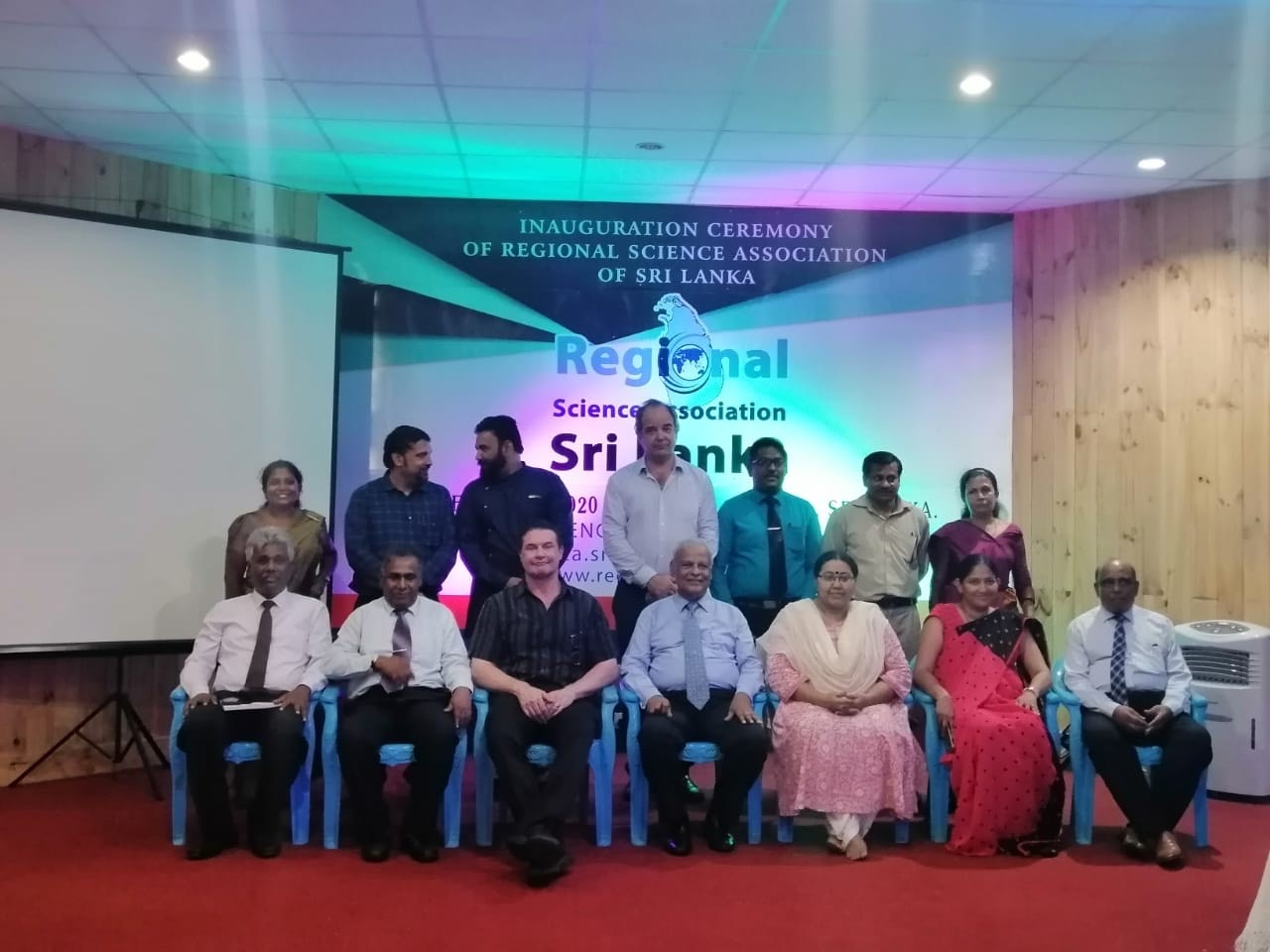
Inauguration Ceremony of Regional Science Association of Sri Lanka
Deadline March 31, 2020 for Registration International Workshop/Competition Rhegion UN 2020 - 2030
The deadline for registration for the International Workshop/Competition Rhegion UN 2020 - 2030 has been postponed to March 31, 2020.
I attach you can find the Call for the International Workshop/Competition.
RSPP Call for Paper | Special Issue on Regional development in Central-Eastern Europe
RSPP Call for Paper
Regional development in Central-Eastern Europe
Regional development of Central-Eastern Europe follows its trajectory, which results from natural, historical, political and social factors. World and European challenges are translated into local actions. Regional policy in Central-European Europe profits from already implemented solutions in other regions, as well as promotes its own policy innovations.
Goal of the special issue on “Regional development in Central-Eastern Europe” is to analyse regional development and policy in wider context. The contributions include, beyond others, policy efficiency, transformation of regions, infrastructure and mobility, living and well-being, aging and silver economy, smart cities, urban and rural development, challenges of environment and natural resources.
Interested scholars are encouraged to submit an article in the platform of Regional Science Policy and Practice until July 31, 2020. The papers will be on-line after accepted by a blind peer review process. The accepted paper will be compiled in a special issue in 2021.
Editors: Katarzyna Kopczewska This email address is being protected from spambots. You need JavaScript enabled to view it.
RSPP Call for Paper | Special Issue on Spatial Resilience and the Border Regions of Europe (NEW DEADLINE)
RSPP Call for Paper
Special Issue on Spatial Resilience and the Border Regions of Europe
One of the least exploited research directions in regional science is the investigation of spatial patterns in relation to resilience, as well as of the role that geographical positioning, respectively the interaction between space and socio-economic activities, play in fostering and enhancing resilience, especially in border regions.
Some key research questions arise as being particularly important for development policies: Are there spatial differences in the resilience outcomes, and have various regions different responses to economic shocks along with their ability to adapt to new economic circumstances, depending on the geographical positioning of a region? Are regions with external borders less resilient to economic, environmental, social or political shocks than regions without any national borders, or with borders that are internal to the EU? Is the impact of a shock on border regions different from the impact on domestic regions? Or does the impact differ on peripheral regions vs. central ones? Can cross-border cooperation reduce border effects and transform borders from a disadvantage into an opportunity? What role do physical, administrative, economic, cultural, institutional, or political barriers have on the resilience of border regions?
This special issue on Spatial Resilience and the Border Regions of Europe aims at responding to some of key challenges for border regions, collecting a set of studies on:
- The principles and effects of spatial resilience (be it cities, regions, rural areas, spatial labor markets, migration, transport systems, public facilities etc.);
- How to better connect and inter-connect the territorial dimension with the economic, social or the ecological issues of resilience in the borderline regions (both external and internal);
- The systemic vulnerability, territorial planning, growth patterns, urban development, quality of life and demographic aspects of cities in the border regions;
- The core-periphery structural differentiation or evolutionary paradigms connected with the resilience capacity;
- Border effects on resilience and the role of cross-border cooperation;
- New approaches on spatial dynamics, from the perspective of the equilibrating forces inherent in regional and urban systems.
Case studies on Romania, Bulgaria, Georgia, Armenia, Belarus, Azerbaijan, Ukraine, Poland, Hungary, Estonia, Leetonia, Latvia, Greece, Turkey, Russia and Finland, but also on the internal “borders” of EU will be more that welcomed.
Papers should be submitted to the regular review process of the journal (https://rsaiconnect.onlinelibrary.wiley.com/journal/17577802) until March 31, 2020.
The coordinators of the Special Issue:
Gabriela Carmen PASCARIU (This email address is being protected from spambots. You need JavaScript enabled to view it.)
Karima KOURTIT (This email address is being protected from spambots. You need JavaScript enabled to view it.)
Ramona TIGANASU (This email address is being protected from spambots. You need JavaScript enabled to view it.)
Call for Papers | Workshop on the Spatial Aspects of Migration, Borders and Integration, COLEF & UP, Tijuana, BC, Mexico, November 9-10, 2020
The Economic Studies Department of the Colegio de la Frontera Norte (COLEF) and Universidad Panamericana (UP) invites scholars to join our conference “Spatial Aspects of Migration, Borders and Integration”.
Topics include but are not limited to, the following:
- Regional economic growth
- International and cross-border trade
- Environmental issues of border
- Cross-border Governance, cooperation and administration
- Migration, third country safe, asylum and refugees
Scholarly articles focus on policy issues in Latin America are especially encourage, but any work with related topics are welcome.
Papers can present the results of research, discuss conceptual approaches to policy implications, describe work in progress or raise issues for debate.
This workshop seeks to gather a group of researchers, academics, and students working in regional economy development topics to discuss research done in the field. It will also contribute to build a network of Latin American economists interested in regional economic development.
Special Issue
The workshop will invite those papers selected and presented at the workshop to the RSPP Special Issue on “Spatial Aspects of Migration, Borders and Integration”.
Keynote Speakers:
In addition to selected paper, presentations there will be four keynote speeches by:
Patricio Aroca Universidad Adolfo Ibáñez
Mark Partridge The Ohio State University
Tomaz Dentinho University of Azores
Neil Reid University of Toledo
Costs:
There is no fee, but registration to the workshop is required by October 10, 2020.
Language:
All Workshop sessions will be held in English.
Submissions:
Prospective participants should submit a full version of the paper in English NLT September 11th, 2020 to: This email address is being protected from spambots. You need JavaScript enabled to view it. . Authors will be notified of the final decision by September 30, 2020.
Please feel free to make any inquiries about the event at the above email address or visit our website https://realmexico.com.mx/
1st AISRe Summer School 2020 | 6-10 July 2020, Milan (IT)
Call
1st AISRe Summer School 2020 | European territorial challenges and regional policy: theories and methods
Venue Milan (IT). Università degli Studi di Milano-Bicocca, Di.SEA.DE
Dates 6-10 July 2020
Objectives and themes
The Summer School will focus on the most relevant theoretical concepts and analytical models in order to understand the implications of the recent territorial challenges in Europe. The goal of the Summer School is to teach a research method for studying complex issues, both positive and normative, with advanced theoretical and methodological tools. Within this framework, the Summer School will address the following topics:
• Development and growth: a comparison between old and new indicators
• Global challenges (migration and global value chain)
• Changing territorial structure (urban regions and major cities)
• Regional policy: instruments, modelling and assessment
Structure of the Program
Each topic will be developed along one day through lessons, seminars on specific topics and tutorial sessions according to the following scheme:
9.30-12.30 a.m. lesson
14.00-16.00 p.m. lesson/seminar/tutorial session
16.30-18.30 Students’ presentation
Confirmed senior scholars with high reputation on the topics of the Summer School will deliver lectures, while experts will conduct seminars and tutorial sessions. All presentations will be in English.
Speakers:
• Development and growth: a comparison between old and new indicators (Paolo Veneri, OECD; Camilla Lenzi, Politecnico di Milano)
• Migrations and globalization: two challenges for territorial development (Alessandra Faggian, GSSI; Laura Resmini, Università di Milano Bicocca; Andrea Ascani, Utrecht University))
• Changing territorial structure (Ezio Micelli, IUAV, Venezia)
• Regional policy: instruments, modelling and assessment (Fabio Mazzola, Universita di Palermo; Andrea Conte, EC-JRC, Sevilla; Simona Comi, Università di Milano-Bicocca; Luca Bettarelli, Università di Milano-Bicocca)
Local Organizing Committee
Laura Resmini, Università di Milano-Bicocca (Co-ordinator)
Luca Bettarelli, Università di Milano-Bicocca
Simona Comi, Università di Milano-Bicocca
Scientific Committee
Roberta Capello (Politecnico di Milano); Cristina Bernini (Università di Bologna); Marusca De Castris (Università degli Studi Roma Tre); Alessandra Faggian (Gran Sasso Science Institute – GSSI); Patrizia Lattarulo (IRPET); Ilaria Mariotti (Politecnico di Milano); Rosanna Nisticò (Università della Calabria); Andrea Omizzolo (EURAC); Guido Pellegrini (Università di Roma La Sapienza); Giovanni Perucca (Politecnico di Milano); Davide Piacentino (Università di Palermo); Vincenzo Provenzano (Università di Palermo); Elena Ragazzi (IRCrES - CNR); Francesca Silvia Rota (IRES Piemonte); Domenico Scalera (Università del Sannio).
How to participate
PhD students and early career researchers with less than 3 years of postdoctoral experience, from Italian universities and research centres can apply to this call.
Candidates must send their CV (Europass format, maximum 5 pages) and an abstract of a research project/paper on which they are currently working (maximum 2,000 words). The selection committee will evaluate the applications on the basis of the documentation submitted. The CV and the quality of the abstract, as far as its consistency with the topics of regional and urban sciences, are the only criteria for the selection.
Candidates have to send their application to the following email address: This email address is being protected from spambots. You need JavaScript enabled to view it. by March 20th 2020. In the object of the email, please specify “NAME OF THE CANDIDATE – Application to the AISRe summer school”.
A maximum of 25 candidates will be selected for participation, and they will receive an email notification by 15th April 2020.
There are no registration fees. Travel, meals and accommodation are at the expense of the participant. Options for accommodation at affordable prices in the university campus will be discussed after the selection of the participants, based on the number of bed places available. Once selected, participants are requested to register as individual member of the Association. Information about membership fees can be found on the Association website (https://www.aisre.it/en/association/membership-and-fees). AISRe membership also includes:
- a subscription to Scienze Regionali (Italian Journal of Regional Science) for the following calendar year (https://www.mulino.it/riviste/issn/1720-3929);
- the volumes of the Regional Science Series (FrancoAngeli) published during the business year;
- the registration to the Regional Science Association International (RSAI), which includes an online subscription to the journals Papers in Regional Science and Regional Science Policy & Practice for the following calendar year;
- the opportunity to pay a reduced fee at the annual conferences of the international associations: European Regional Science Association (ERSA) (www.ersa.org) and Regional Science Association International (RSAI) (https://regionalscience.org/).
A certificate of attendance will be issued at the end of the school, for full participation only.
Fully funded PhD Opportunity at the Fraser of Allander Institute
This fully funded PhD project will use a combination of econometric and computable general equilibrium (CGE) modelling techniques to look at the impact of high-tech new businesses on employment in local and regional economies.
This project aims at capturing and measuring the impact of new businesses generation on local and regional economies in the UK. Attracting new, particularly high productivity, businesses is a policy priority of the UK government and underpins the UK Government’s Industrial Strategy. One reason for this is that when new businesses are started in local area, new jobs are created both in the same industry and in other industries, due to the increase in demand for local goods. This is known as the local employment multiplier effect.
The hope of government is that by attracting new, high productivity, firms to parts of the UK which lack these sorts of jobs, that this will create spillover employment effects throughout regional and local economies. However, these positive impacts may be offset by a series of general equilibrium forces that could result for example in an overall increase in the cost of living in the area.
This project will combine detailed microeconometric work and multi-sectoral multi-regional CGE modelling to produce a strong evidence base on the magnitude of UK local employment multipliers. The first part of this work will involve the use of firm—level and individual level microdata to better understand and model key inputs to the assessment of local employment multipliers. The second part of this work will develop and use a multiregional CGE model of the UK to capture induced and general equilibrium effects.
More information can be found here:
https://www.strath.ac.uk/studywithus/postgraduateresearchopportunities/businesspgropportunities/economicspgropportunities/canlocalareasgainnewjobswhennewhigh-techbusinessesareattracted/
The deadline to apply is: 30 April 2020
Supervisors: Gioele Figus, This email address is being protected from spambots. You need JavaScript enabled to view it. and Stuart Mcintyre, This email address is being protected from spambots. You need JavaScript enabled to view it.
Call for papers for the conference Living together in the city of Tomorrow, Lyon 9-10 September 2020
Call for papers for the conference
Living together in the city of Tomorrow
Lyon 9-10 September 2020
Colloque de la Chaire Habiter Ensemble la Ville de Demain
Appel à Communications
Titre : Habiter ensemble la ville de demain
Résumé :
Dans les sociétés occidentales où le mode de vie urbain est devenu largement dominant, les modalités de bâtir et d’habiter la ville sont soumises à des injonctions et des tensions complexes, comprenant entre autres l’adaptation au changement climatique et la lutte contre les inégalités socio-spatiales. Ces questions transversales affectent toutes les dimensions de l’évolution urbaine. L’accent est mis dans ce colloque sur la dimension résidentielle du changement urbain, les modalités de bâtir et d’habiter la ville. On interrogera notamment la production de logements abordables, le renouvellement urbain, la densification, les évolutions du logement social, la demande de participation dans la conception de l’habitat et plus largement dans l’habiter. L’interrogation transversale qui parcourt le colloque est celle du rôle de l’habitat dans le devenir des sociétés urbaines, sa capacité à renforcer ou restaurer des formes de cohésion sociale et spatiale. Partant des questions qui ont nourri ses travaux, la Chaire de recherche du Labex Intelligences des Mondes Urbains « Habiter Ensemble la Ville de Demain » (HEVD) élargit ses réflexions à d’autres terrains, d’autres expériences pratiques et scientifiques à l’occasion de ce colloque.
Annonce :
Dans les sociétés occidentales où le mode de vie urbain est devenu largement dominant, les modalités de bâtir et d’habiter la ville sont soumises à des injonctions et des tensions complexes, comprenant entre autres l’adaptation au changement climatique et la lutte contre les inégalités socio-spatiales. Quelles sont et quelles seront les conditions de possibilité d’un « Habiter ensemble » dans la ville de demain ? La réponse à cette question peut emprunter de multiples voies, tant la notion d’habiter est transverse et englobe très largement la manière d’« être au monde ». Nous adoptons ici une acception du verbe « habiter » dans sa relation directe avec l’habitat, la composante résidentielle de la ville, qui constitue la très grande majorité de l’espace bâti et du paysage urbains. Comment l’habitat, dans sa dimension matérielle, morphologique, mais aussi politique et sociale est-il en mesure d’apporter des réponses aux défis de la cohésion sociale et spatiale en milieu urbain ? Le « vivre ensemble », demeure en effet un horizon d’attente, toujours discuté, rarement atteint ; pour s’en approcher, on peut convoquer des mesures relevant de multiples registres : éducatives, culturelles, politiques, fiscales, etc... L’habitat, qui répond à un besoin fondamental, joue un rôle essentiel. La manière dont il est conçu, produit, financé, mis sur le marché, peuplé et habité, détruit et reconstruit, oriente en effet la qualité de vie, la résorption des inégalités à la fois sociales et spatiales. Mais jusqu’à quel point ?
Pour cela il faut s’intéresser à la question de l’habitat à différentes échelles. La question de l’ « habiter ensemble » peut s’entendre sur un territoire d’observation vaste, de dimension métropolitaine, mais peut également être questionné à des niveaux d’observation plus fins, comme le quartier, l’immeuble, voire la cage d’escalier. Entre des quotas de logement sociaux atteints ou pas dans les communes d’une communauté d’agglomération et les partages de l’espace au sein d’un immeuble répondant à un programme mixte d’habitat en copropriété et d’habitat social, la question est au fond la même : comment s’assurer d’une cohabitation effective, constructive et sereine de catégories de logements et de ménages que les logiques de marché et des choix politiques tendent à séparer ? La lancinante question de la proximité spatiale, dont on sait bien qu’elle ne produit pas nécessairement de fortes interactions sociales, et ceci à diverses échelles là aussi, mérite toujours d’être posée. Cette observation multi-scalaire des dynamiques résidentielles sera menée à la fois en ce qui concerne la production de l’espace habité et la transformation de l’existant à travers les opérations de renouvellement urbain.
Une autre entrée majeure sera celle des acteurs susceptibles de transformer les situations héritées et d’orienter l’habitat et l’habiter du futur. On le sait, ils sont multiples et en pleine évolution en ce début de XXI° siècle. Les acteurs politiques ont leur part, à différents niveaux d’intervention : l’État dans les pays où celui-ci accorde une attention soutenue au logement, les régions dans d’autres cas. Partout s’ajoutent à ces niveaux définissant les stratégies et orientations les acteurs politiques investis des compétences d’aménagement et d’urbanisme au plus près du terrain, les élus et techniciens locaux. Les acteurs économiques jouent un rôle non moins important, qu’il s’agisse de grands groupes ou de petites entreprises, dans la production, la commercialisation et la gestion de l’habitat. Les choix techniques, organisationnels, économiques des constructeurs, promoteurs, architectes, urbanistes et bailleurs sont des éléments clés car ils définissent une offre, des prix, des logiques d’aménagement et de peuplement. Les collectifs associatifs et citoyens s’investissent également de plus en plus dans la conception de l’habitat ou les modalités de l’habiter, seuls ou en partenariat avec des acteurs économiques et politiques, dans un dialogue apaisé ou revendicatif, pour agir sur l’évolution de l’espace habité constitué.
Plusieurs axes de réflexion sont proposés dans ce colloque. Les communications proposées peuvent faire état de situations françaises ou étrangères, et relever d’un large spectre disciplinaire des SHS (urbanisme, géographie, économie, sociologie, anthropologie, architecture, …).
- Orienter
La manière de construire la ville, des immeubles d’habitation, s’appuie sur des orientations, des choix issus des acteurs mentionnés plus haut. Selon leur position, leur capacité d’agir, ceux-ci sont en mesure d’orienter le devenir de l’habitat et de l’habiter, dans une relation mutuelle de complémentarité, de dialogue, ou de tension. Cette orientation prend des formes d’actions très diverses : gouvernement, conception, peuplement, allocation (de ressources foncières, de logements), participation, contestation, adaptation (aux contraintes énergétiques, de changement climatique, de mobilité), innovation.
- Former
Cet axe insiste sur les formes de l’habitat et leur capacité à renforcer ou recréer une ville cohésive et solidaire, mais aussi à répondre aux attentes sociétales et à des contraintes structurelles. Là aussi la démarche multi-scalaire invite à observer les tendances actuelles ou passées dans la forme de l’habitat à l’échelle micro (celle de l’immeuble) mais aussi à l’échelle de l’espace urbanisé (communauté d’agglomération, métropole). Quelles sont les attentes de la société, les offres des acteurs face à la forme de l’habitat, à la fois en ce qui concerne son emprise au sol (densité vs étalement) et ses volumes (habiter en hauteur) ?
- Partager
En ce début de XXIème siècle, plusieurs postulats de la ville moderne ont été profondément remis en cause, comme celui de la séparation fonctionnelle de l’espace urbain. La mixité fonctionnelle, sociale, résidentielle impose de partager les ressources foncières, résidentielles à différentes échelles. Quelles réponses apportent à l’habiter ensemble la mixité d’usages dans la promotion résidentielle, la conception d’espaces partagés dans les immeubles, très prisée dans les projets d’habitat participatif, la mixité habitat social/en accession au sein des programmes immobiliers ?
Cet axe sera également ouvert à des interventions réfléchissant sur l’intérêt de partager des connaissances théoriques et empiriques, des expériences de recherche et des pratiques : quels sont les apports, les innovations issues du dialogue science –société ? Quelles en sont aussi les difficultés du côté du partage des rôles ? Ces questions se posent à propos d’interventions conjointes entre acteurs politiques ou économiques et chercheurs, mais aussi de celles impliquant chercheurs et collectifs associatifs voire militants.
Modalités pratiques
-28 février 2020 : date limite de remise des propositions de contribution de 500 mots au maximum, en français, en indiquant dans quel axe se situe la communication. Prière d’envoyer les communications à l’adresse suivante : This email address is being protected from spambots. You need JavaScript enabled to view it..
Chaque proposition de communication sera évaluée de façon anonyme par deux lecteurs du comité scientifique à partir d’une grille d’analyse.
-20 avril 2020 : Confirmation des propositions retenues
-9 et 10 septembre 2020 : Colloque à Lyon
Conseil scientifique :
Manuel Appert, École Nationale Supérieure d’Architecture de Lyon, UMR EVS
Jean-Yves Authier, Université Lumière Lyon 2, UMR Centre Max Weber
Loïc Bonneval, Université Lumière Lyon 2, UMR Centre Max Weber
Jean Cavailhès, INRA, UMR Cesaer, Dijon
Lydia Coudroy de Lille, Université Lumière Lyon 2, UMR EVS
Jean-Claude Driant, École d’Urbanisme de Paris, Lab’Urba
Yankel Fijalkow, École Nationale Supérieure d’Architecture de Paris Val de Seine, UMR LAVUE
Florence Goffette Nagot, CNRS, UMR GATE
Magda Górczyńska, Luxembourg Institute of Socio-Econonomic Research
Christine Lelévrier, École d’Urbanisme de Paris, Lab’Urba
Aurore Meyfroidt, POPSU
Christelle Morel Journel, Université Jean Monnet Saint-Étienne, UMR EVS
Vincent Veschambre, Le Rize, UMR EVS
Comité d’organisation :
Manuel Appert, École Nationale Supérieure d’Architecture de Lyon, UMR EVS
Lydia Coudroy de Lille, Université Lumière Lyon 2, UMR EVS
Guénola Inizan, Université Lumière Lyon 2, UMR EVS
Anne-Cécile de Giacomoni, Université de Lyon, Lyon Ingénierie Projet
Véronique Sanvoisin, INSA Lyon, LabEx IMU
Lieu : Lyon
Dates : 9 et 10 septembre 2020
The Annals of Regional Science, Vol. 64, Issue 1 - New Issue Alert
|
|||||
|
|||||
|
Important news |
|||||
|
|||||
|
In this issue |
|||||
|
|||||
|
|||||
|
|||||
|
|||||
|
|||||
|
|||||
|
|||||
|
|||||
|
|||||
|
|||||
|
|||||
|
|||||
|
|||||
|
|||||
|
|||||
|
|||||
|
|||||
|
|||||
|
|||||
|
|||||
|
|||||
|
|||||
|
|||||
|
|||||
|
Important news |
|||||
|
About Us
The Regional Science Association International (RSAI), founded in 1954, is an international community of scholars interested in the regional impacts of national or global processes of economic and social change.