PROGRAMME
Last update: 02/06/2026
|
|
|

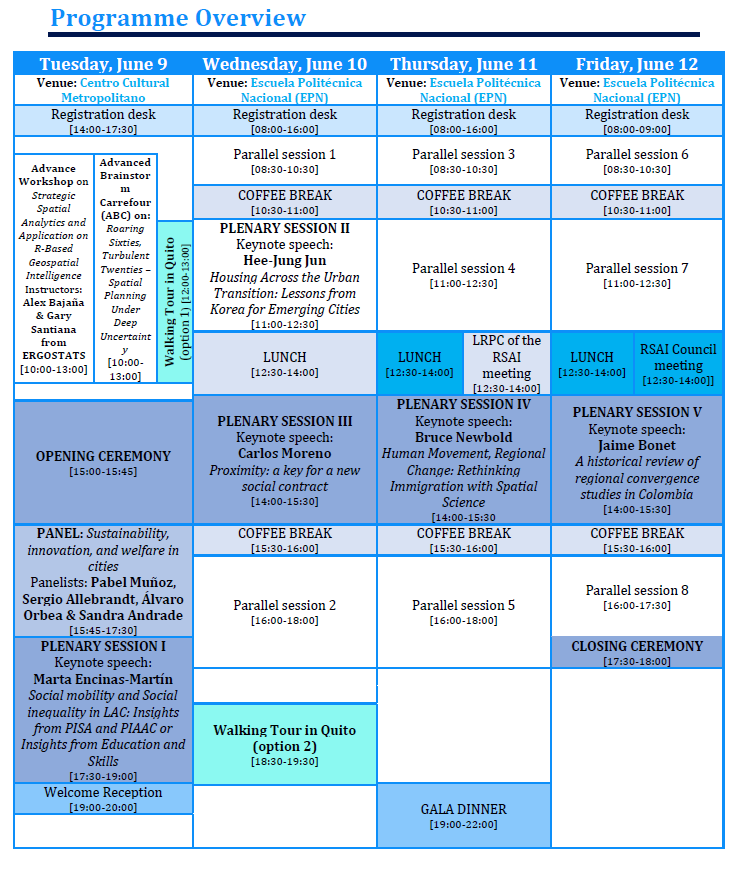
Training Course
Advance Workshop on Strategic Spatial Analytics and Application on R-Based Geospatial Intelligence
Tuesday, June 9 from 10:00 to 13:00
Instructors: Alex Bajaña & Gary Santiana from ERGOSTATS
This training course focuses on spatial analysis techniques using R, with a focused application to spatial accessibility to healthcare services. The workshop combines conceptual foundations with practical programming sessions to equip participants with the skills needed to measure and interpret spatial accessibility to services. Emphasis is placed on advanced accessibility methodologies, particularly the Two-Step Floating Catchment Area (2SFCA) method and its enhanced version (E2SFCA/ES2FCA), alongside other approaches such as gravity models and provider-to-area ratios.
Participants work with real data, including census zones, hospital locations, population data and health service capacity records. Using GIS tools and R packages, they construct travel-time isochrones, build spatial influence matrices, apply distance-decay functions, and compute spatial accessibility indicators such as the Spatial Access Index (IAE) and Spatial Access Coefficient (CAE).
The course bridges theory and application by enabling attendees to identify territorial inequalities in healthcare access and interpret spatial patterns to inform public health planning and resource allocation decisions.
Registration:
The advanced workshop is free for all 2026 RSAI congress participants, but prior registration is required.
The number of participants is limited to 30; spaces are allocated in order of receipt.
The participant just need to send an email to rsai@apdr.pt, requesting the registration on the Workshop.
Tuesday, June 9 from 10:00 to 13:00
Instructors: Alex Bajaña & Gary Santiana from ERGOSTATS
This training course focuses on spatial analysis techniques using R, with a focused application to spatial accessibility to healthcare services. The workshop combines conceptual foundations with practical programming sessions to equip participants with the skills needed to measure and interpret spatial accessibility to services. Emphasis is placed on advanced accessibility methodologies, particularly the Two-Step Floating Catchment Area (2SFCA) method and its enhanced version (E2SFCA/ES2FCA), alongside other approaches such as gravity models and provider-to-area ratios.
Participants work with real data, including census zones, hospital locations, population data and health service capacity records. Using GIS tools and R packages, they construct travel-time isochrones, build spatial influence matrices, apply distance-decay functions, and compute spatial accessibility indicators such as the Spatial Access Index (IAE) and Spatial Access Coefficient (CAE).
The course bridges theory and application by enabling attendees to identify territorial inequalities in healthcare access and interpret spatial patterns to inform public health planning and resource allocation decisions.
Registration:
The advanced workshop is free for all 2026 RSAI congress participants, but prior registration is required.
The number of participants is limited to 30; spaces are allocated in order of receipt.
The participant just need to send an email to rsai@apdr.pt, requesting the registration on the Workshop.

Walking Tours in Quito

- Option 1 - Tuesday, June 9 from 12:00-13:00 (The number of participants is limited to 60)
- Option 2 - Wednesday, June 10 from 18:30-19:30 (The number of participants is limited to 45)
Registration:
The Walking Tours in Quito are free for all participants of the 2026 RSAI Congress, but prior registration is required.
Spaces will be allocated on a first-come, first-served basis.
To register for the Walking Tours in Quito, please send an email to rsai@apdr.pt, specifying whether you would like to sign up for Option 1 or Option 2.
Activities
Meeting Point: Tienda Quito of the Palacio Municipal building - https://maps.app.goo.gl/1bWs37DKK7JuP91j6
Visit to the architectural complex of the façades at Plaza Grande
Street of the Seven Crosses
- Façade of the Metropolitan Cultural Center
- Façade of El Sagrario Church
- Façade of La Compañía Church
This is the most important site in the Historic Center, where visitors can observe the daily dynamics of many residents of Quito. Since the 16th century, it has been an outstanding meeting point and the setting for many legends and chronicles of the city. The square is bordered by the Metropolitan Cathedral to the south, the Presidential Palace to the west, the Archbishop’s Palace to the north, and the Municipal Palace to the east.
On the sides and in front of the Cathedral you will find cafés where you can taste pernil sandwiches, fresh fruit juices, and seco de chivo, dishes that have preserved culinary traditions for generations.
The tour continues with a walk along the façades of the main buildings located on the Street of the Seven Crosses.
Metropolitan Cultural Center
The Metropolitan Cultural Center is a cultural institution in the city of Quito, the capital of Ecuador. Its main headquarters is located in the historic center of the city, in one of the monumental buildings that contributed to Quito being declared the first World Cultural Heritage Site by UNESCO in 1978.
The land where the Metropolitan Cultural Center stands today belonged to the Jesuit order since the founding of the city. In 1622 the Jesuits built the University of San Gregorio Magno there. When the Jesuits were expelled from the territories in 1767, the university passed into the hands of the Spanish Crown, which merged it with the Dominican university under the name Royal Public University of Santo Tomás de Aquino.
After independence, in 1826 the Congress of Cundinamarca established the Central University of the Department of Quito, using the same colonial building. Later, after the creation of the Republic of Ecuador, the institution became what is now known as the Central University of Ecuador in 1836.
El Sagrario Church
El Sagrario Church is a Catholic temple located in the city of Quito, Ecuador’s capital. It is situated in the Historic Center on García Moreno Street, formerly known as the Street of the Seven Crosses, just a few meters from the intersection with Eugenio Espejo Street.
It forms part of the architectural complex of the Metropolitan Cathedral, although due to its size and significance it appears more like an independent church than an attached chapel. It holds an important place in Quito’s cultural imagination.
Church of La Compañía
Considered “the jewel of Baroque architecture in America,” this site impresses visitors with the beauty and splendor of its interior, which is covered with gold leaf. Its Baroque façade is a true work of art built with volcanic stone.
San Francisco Church
The Church of San Francisco is a Catholic basilica located in the historic center of Quito, facing the square of the same name. The structure forms the largest architectural complex within the historic centers of the Americas, which is why it is often referred to as the “Escorial of the New World.”
San Francisco is considered a masterpiece of continental architecture due to the combination of different styles developed over more than 150 years of construction.
Across its three and a half hectares, thirteen cloisters have been built (six of them of great size), along with three churches and a large atrium, totaling approximately 40,000 square meters of construction.
Today, multiple activities take place there, including conventual and religious functions, public services in health and communication, educational programs, and other community-oriented activities that keep the complex active.