
RSAI Founder's Medal
Elisabete Martins
The New Issue of Regional Statistics is already Available! (2026, VOL 16, No 6)
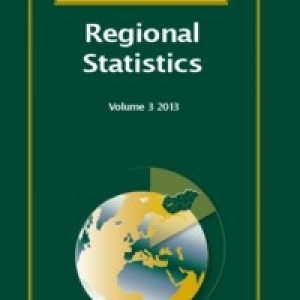
REGIONAL STATISTICS, 2026, VOL 16, No 6.
STUDIES
Dear Readers,
We are pleased to say that the 6/2026 issue of Regional Statistics has been published and available online!
CONTENT
Budi Susetyo – Asrirawan – I Made Sumertajaya – Anang Kurnia: Spatial similarity of daily rainfall patterns in Indonesia: a biclustering approach with missing data
https://www.ksh.hu/statszemle_archive/regstat/2026/2026_06/rs160601.pdf
Sylvia Graczka: Measuring avoided material – a proposal for a multilevel indicator system
https://www.ksh.hu/statszemle_archive/regstat/2026/2026_06/rs160602.pdf
My Nguyen – Su Ha Van – Tuyen Tran Quang: When water rises: the energy consequences of district-level floods on Vietnamese firms
https://www.ksh.hu/statszemle_archive/regstat/2026/2026_06/rs160603.pdf
Rezzy Eko Caraka – Vijaya Isnaniawardhani – Rung Ching Chen – Prana Ugiana Gio – Shao Kuo Tai – Emi Sukiyah – Esa Prakasa – Bens Pardamean: GeoAI-based modelling of traffic accident hotspots in Taiwan using neural spatial point processes
https://www.ksh.hu/statszemle_archive/regstat/2026/2026_06/rs160604.pdf
Yize Li – Yi Wang – Woosik Yu: Immigration and regional economic development: the case of Spain
https://www.ksh.hu/statszemle_archive/regstat/2026/2026_06/rs160605.pdf
Tamás Wittmann – Norbert Papp: Demographic changes in the Baranya Triangle of Croatia from the early 20th century to the present
https://www.ksh.hu/statszemle_archive/regstat/2026/2026_06/rs160606.pdf
José Fernando Vasco Leal – Roberto Yoan Castillo Diéguez – Alfonso Carrillo Hernández: Value chain integration, market power, and price stability in Mexican floriculture: evidence from Querétaro’s rose producers
https://www.ksh.hu/statszemle_archive/regstat/2026/2026_06/rs160607.pdf
Géza Tóth: Urban demographic processes in Europe, 2011–2021
https://www.ksh.hu/statszemle_archive/regstat/2026/2026_06/rs160608.pdf
Join us to our social networking sites:
New "Arthur Getis Dissertation Award" Honors Pioneer of Spatial Analysis
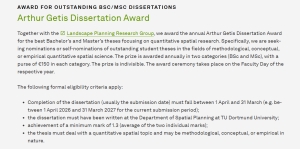
The Department of Spatial Planning at Technische Universität Dortmund (TU Dortmund), Germany, has established the annual Arthur Getis Dissertation Award to recognize outstanding Bachelor's and Master's dissertations with a quantitative spatial focus.
Initiated by Prof. Dr. René Westerholt (Spatial Modeling Lab) and Dr. Aude Zingraff-Hamed (Landscape Planning Research Group), the prize commemorates the life and enduring global legacy of Professor Arthur Getis (1934–2022) -- recipient of the most prestigious RSAI awards (the Jean Paelinck Award and the RSAI Founder’s Medal), and one of the founding figures of modern spatial statistics and quantitative geography. The award celebrates his lifelong commitment to advancing spatial analytical methods and bridging geography, regional science, and the social sciences.
Awarded annually on TU Dortmund's Faculty Day, the prize honors one Bachelor's and one Master's thesis completed at the Department of Spatial Planning that demonstrates exceptional analytical rigor, originality, and relevance to quantitative spatial science. Further details and award guidelines are available on the TU Dortmund Spatial Modeling Lab website.
https://ram.raumplanung.tu-dortmund.de/teaching/arthur-getis-dissertation-award
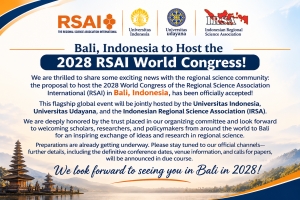
Bali, Indonesia to Host the 2028 RSAI World Congress!
New Issue: Regional Science Policy & Practice | Volume 18, Issue 11, November 2026
|
|
Articles
|
|
|
|
|
|
Book Reviews
|
|
Call for Papers | RSPP Special Issue: The Uneven Regional Geographies of Re-bordering and Geoeconomic Fragmentation

Regional Science Policy & Practice (RSPP)
Call for Papers Special Issue:
The Uneven Regional Geographies of Re-bordering and Geoeconomic Fragmentation
Guest Editors:
Francesco Molica (chair), ULB - Université libre de Bruxelles, Belgium. Email: This email address is being protected from spambots. You need JavaScript enabled to view it.
Francesco Cappellano, Kiel University, Germany. Email: This email address is being protected from spambots. You need JavaScript enabled to view it.
Teemu Makkonen, University of Eastern Finland, Finland. Email: This email address is being protected from spambots. You need JavaScript enabled to view it.
Anabela Santos, ULB - Université libre de Bruxelles, Belgium. Email: This email address is being protected from spambots. You need JavaScript enabled to view it.
Aim of the special issue:
Over the past decade, the international economic order has become increasingly shaped by processes of re-bordering, geopolitical fragmentation, trade tensions, sanctions, supply-chain disruptions, and renewed concerns over economic security. These developments challenge long-standing assumptions, including in the field of economic geography, about globalization, regional integration, and the progressive erosion of national borders. While most discussions have been conducted through a (supra-)national lens, they equally demand a more granular perspective looking into the spatial implications, namely, the impact on the mechanisms and factors underpinning regional development processes. Indeed, these emerging trends are producing new and highly uneven territorial effects across regions, sectors, and scales which have yet to be investigated comprehensively (Molica et al., 2026; Caragliu and Dellisanti, 2026)
The Special Issue aims to examine how international re-bordering and geoeconomic fragmentation are reshaping regional development trajectories. It seeks to bring together theoretically informed and empirically grounded contributions exploring how regions are exposed to, interpret, and respond to the reconfiguration of borders, trade relations, value chains, energy systems, and international investment flows.
The Special Issue builds on the multiscale debates connnecting deglobalization, regional resilience, border studies, global production networks, industrial restructuring, and territorial transformation (Yeung, 2025; Boschma, 2015; Gong et al., 2022). Its central premise is that geopolitical and economic disruptions do not affect all territories in the same way. Their consequences depend on regional economic structures, institutional capacities, geographical location, cross-border dependencies, sectoral specialization, and the agency of public and private actors.
This perspective also raises broader questions for Evolutionary Economic Geography (EEG). Regional trajectories are commonly understood as the outcome of historically accumulated capabilities, institutional structures, industrial specializations, and processes of path dependence and diversification. Yet major geopolitical, geoeconomic, and environmental transformations may originate largely outside regional economies while profoundly altering the conditions under which regional development unfolds. Trade conflicts, sanctions, military confrontations, climate-related disruptions, border closures, or shifts in industrial and economic-security policies may therefore act not simply as temporary external shocks, but as forces capable of redirecting, accelerating, constraining, or disrupting existing regional trajectories.
Understanding these processes requires greater attention to how macro-scale transformations are translated into territorially differentiated processes of regional change. Their effects depend on the interaction between external pressures and region-specific economic structures, capabilities, institutions, geographical positions, and actor strategies. From this perspective, geoeconomic fragmentation provides an opportunity to reconsider how exogenous transformations interact with endogenous processes of regional evolution, potentially generating path disruption, adaptation, renewal, or the emergence of new development trajectories.
Re-bordering and fragmentation should therefore be understood as a multi-scalar process. Decisions taken at the international or national level, including border closures, tariffs, sanctions, industrial policies, and investment restrictions, can generate profound effects at the regional and local levels. At the same time, regions are not merely passive recipients of external shocks. Regional institutions, firms, policy actors, and communities may develop strategies of adaptation, diversification, resistance, or repositioning within emerging economic geographies.
Potential contributions may address, but are not limited to, the following themes:
- the regional effects of sanctions, trade wars, and changing international relations;
- regional responses to energy crises and disruptions in energy supply;
- deglobalization and the transformation of established industrial regions;
- the emergence of new regional production and investment hubs in times of geopolitical uncertainty;
- regional resilience, vulnerability, and adaptive capacity in the face of geoeconomic fragmentation;
- the role of regional institutions, firms, and policy actors in responding to external geopolitical shocks
- the role of public policy in cross-border regions in times of security uncertainty
Several empirical contexts illustrate the relevance of this agenda. Finnish border regions, for example, are facing substantial economic and social costs following the closure of the border with Russia and the weakening of long-established cross-border relations. European regions have also been unevenly affected by the recent energy crisis and by disruptions in energy-intensive value chains. In the automotive sector, established production regions such as Bavaria are confronting growing pressures linked to technological transition and global competition, while some Spanish regions are attracting new investments from Chinese electric-vehicle manufacturers.
These examples point to a broader research question: how does geopolitical fragmentation contribute to the decline, adaptation, or emergence of regional development trajectories?
The Special Issue welcomes comparative studies, single-region case studies, sectoral analyses, conceptual contributions, and papers using quantitative, qualitative, or mixed methods. Contributions should seek to advance understanding of the mechanisms through which international re-bordering and economic fragmentation produces differentiated regional outcomes and of the strategies through which regions respond to an increasingly fragmented global economy.
Through this collection, the Special Issue aims to contribute to a more territorially sensitive understanding of contemporary geopolitical and economic change, while also generating insights relevant to regional, industrial, and cross-border policy.
Review process:
As with all academic submissions to the journal, the process will involve peer review. Each paper will be sent to at least two anonymous reviewers. If the reviews are favorable, authors will be asked to make revisions in line with the feedback before final acceptance.
This ensures that the Special Issue maintains high scholarly standards and remains impactful both within and beyond academia.
Open access and fees:
Regional Science Policy & Practice is a gold open-access journal. This means that articles accepted for publication will be subject to the payment of an Article Publishing Charge (APC). Standard fees are described in detail on the journal home page (https://www.sciencedirect.com/journal/regional-science-policy-and-practice).
Submission:
All manuscripts will be submitted via the Regional Science Policy & Practice online submission system (https://www.editorialmanager.com/rspp/). Authors should indicate in the cover letter that the paper is submitted for consideration for publication in this special issue and select in the article type the correct SI theme; otherwise, your submission will be handled as a regular manuscript.
Deadline for submissions:
Abstract submission deadline: February 28, 2027 (send by email to Francesco Molica - This email address is being protected from spambots. You need JavaScript enabled to view it.)
Paper submission deadline: September 1, 2027
REMINDER | Call for Applications | Peter Nijkamp Award - Deadline: November 30th 2026

Dear RSAI members,
Did you know that as a member of your local Regional Science Association, you automatically hold membership in the Regional Science Association International (RSAI)?
We are writing to highlight an exciting opportunity available through your international membership. The RSAI administers a prestigious accolade specifically for researchers from and based in developing nations: The Peter Nijkamp RSAI Research Encouragement Award for a Mid-Career Scholar from a Developing Country.
Key Details
- The Award: Recognizes outstanding potential in mid-career spatial and regional science researchers, funding up to €750 in travel, accommodation, and registration costs to attend a major supranational RSAI conference or the RSAI World Congress.
- Eligibility: Open to RSAI members in good standing who completed their PhD within the last 10 years and are working full-time at an institution within a low, lower-middle, or upper-middle-income country (as classified by the World Bank).
- Application Deadline: November 30, 2026
If you meet these criteria, we cordially invite you to review the full guidelines and submit your application. If you are not yet eligible, we encourage you to keep this opportunity in mind for your future career milestones.
For full submission details, required documents, and eligibility lists, please visit the official Peter Nijkamp Research Award Page. (https://www.regionalscience.org/index.php/awards/peter-nijkamp-research-award.html)
Best regards
Dr Ana Viñuela
RSAI Executive Director
NARSC 2026 Conference and Final Program
|


In Memoriam: Professor Franz Tödtling

 On October 6, Professor Franz Tödtling of the Vienna University of Economics and Business (WU Wien), Vienna, Austria, passed away unexpectedly.
He was a very active and valued member of the RSAI community, ERSA, and the German-speaking Section of RSAI.
Franz Tödtling dedicated his academic career to the study of regional development and regional policy. He authored and edited nine books and published around 250 articles, many of them in highly respected international journals.
Since the early 1980s, Franz had been an active and regular participant in ERSA's annual conferences and in the winter seminars of the German-speaking Section of RSAI.
He maintained an extensive network of research collaborations throughout Europe and beyond.
Franz will be greatly missed by all of us, not only for his intellectual strength but also for his warm personality. He was a dear friend and a generous source of support and encouragement to younger members of our communities throughout their academic careers.
Our deepest sympathies go to his family and to all those who were close to him.
RSAI Councillors at large elected for the 2027-2029 term
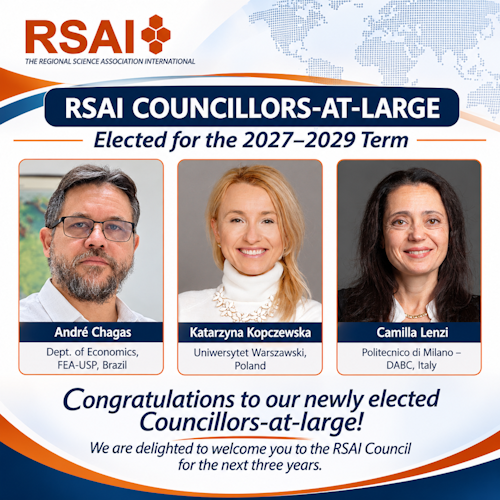
During the month of October, RSAI members voted for the election of new Councillors at large on the RSAI Council for the 2027-2029 term. The following three candidates were eventually elected:
- André Chagas (Dept. of Economics, FEA-USP, Brazil)
- Katarzyna Kopczewska (Uniwersytet Warszawski, Poland)
- Camilla Lenzi (Politecnico di Milano – DABC, Italy)
We would like to congratulate them on this achievement. We are very happy to have you on board for the next three years!
The Maxine Goodman Levin School of Urban Affairs seeks adynamic faculty member at the rank of Assistant Professor
The Maxine Goodman Levin School of Urban Affairs seeks adynamic faculty member at the rank of Assistant Professor. The start date is August 16, 2027.
Successful candidates will contribute fully to the Levin School through teaching, research, and service. While we will consider all areas of expertise related to urban planning and/or urban affairs, we are particularly interested in candidates who can bolster our research and teaching portfolio in urban real estate development and finance; community development; environmental planning and policy; and/or applications of data science and/or AI in urban affairs research and practice. We especially encourage candidates who have experience and interest in engaged teaching and research.
This position requires teaching on-campus courses. In addition, you may be assigned to teach off campus, evenings, weekends, and via distance learning technology, depending upon student need for the delivery of instructional services.
The Levin School of Urban Affairs is ranked among the top urban affairs schools in the nation, including #3 in urban policy and #10 in local government. The school offers four master’s degrees including the fully accredited Master of Public Administration and Master of Urban Planning and Development, along with a Master of Nonprofit Administration and Master of Science in Urban Studies. We also have a Ph.D. in Urban Studies & Public Affairs and six undergraduate majors in community planning, environmental studies, nonprofit administration, organizational leadership, public policy and management, and public safety management.
The Levin School is housed within the Levin College of Public Affairs and Education, which also includes the School of Education & Counseling, the School of Communication, and the Department of Criminology and Sociology. The Levin College houses a number of research and career enhancement centers such as the Center for Economic Development, the Energy Policy Center, and the Center for Public and Nonprofit Management. This dynamic environment provides opportunities for interdisciplinary, applied, and engaged research and teaching.
CSU aspires to be a national leader in social and economic mobility. We will be a great place to learn and work. CSU is striving to be a nationally recognized and student focused public research institution that provides accessible, affordable, and Engaged Learning opportunities for all.
For more information and how to apply, please visit: https://hrjobs.csuohio.edu/postings/27380
About Us
The Regional Science Association International (RSAI), founded in 1954, is an international community of scholars interested in the regional impacts of national or global processes of economic and social change.