
Publications
Elisabete Martins
Call for Papers | RSPP Special Issue: The Uneven Regional Geographies of Re-bordering and Geoeconomic Fragmentation

Regional Science Policy & Practice (RSPP)
Call for Papers Special Issue:
The Uneven Regional Geographies of Re-bordering and Geoeconomic Fragmentation
Guest Editors:
Francesco Molica (chair), ULB - Université libre de Bruxelles, Belgium. Email: This email address is being protected from spambots. You need JavaScript enabled to view it.
Francesco Cappellano, Kiel University, Germany. Email: This email address is being protected from spambots. You need JavaScript enabled to view it.
Teemu Makkonen, University of Eastern Finland, Finland. Email: This email address is being protected from spambots. You need JavaScript enabled to view it.
Anabela Santos, ULB - Université libre de Bruxelles, Belgium. Email: This email address is being protected from spambots. You need JavaScript enabled to view it.
Aim of the special issue:
Over the past decade, the international economic order has become increasingly shaped by processes of re-bordering, geopolitical fragmentation, trade tensions, sanctions, supply-chain disruptions, and renewed concerns over economic security. These developments challenge long-standing assumptions, including in the field of economic geography, about globalization, regional integration, and the progressive erosion of national borders. While most discussions have been conducted through a (supra-)national lens, they equally demand a more granular perspective looking into the spatial implications, namely, the impact on the mechanisms and factors underpinning regional development processes. Indeed, these emerging trends are producing new and highly uneven territorial effects across regions, sectors, and scales which have yet to be investigated comprehensively (Molica et al., 2026; Caragliu and Dellisanti, 2026)
The Special Issue aims to examine how international re-bordering and geoeconomic fragmentation are reshaping regional development trajectories. It seeks to bring together theoretically informed and empirically grounded contributions exploring how regions are exposed to, interpret, and respond to the reconfiguration of borders, trade relations, value chains, energy systems, and international investment flows.
The Special Issue builds on the multiscale debates connnecting deglobalization, regional resilience, border studies, global production networks, industrial restructuring, and territorial transformation (Yeung, 2025; Boschma, 2015; Gong et al., 2022). Its central premise is that geopolitical and economic disruptions do not affect all territories in the same way. Their consequences depend on regional economic structures, institutional capacities, geographical location, cross-border dependencies, sectoral specialization, and the agency of public and private actors.
This perspective also raises broader questions for Evolutionary Economic Geography (EEG). Regional trajectories are commonly understood as the outcome of historically accumulated capabilities, institutional structures, industrial specializations, and processes of path dependence and diversification. Yet major geopolitical, geoeconomic, and environmental transformations may originate largely outside regional economies while profoundly altering the conditions under which regional development unfolds. Trade conflicts, sanctions, military confrontations, climate-related disruptions, border closures, or shifts in industrial and economic-security policies may therefore act not simply as temporary external shocks, but as forces capable of redirecting, accelerating, constraining, or disrupting existing regional trajectories.
Understanding these processes requires greater attention to how macro-scale transformations are translated into territorially differentiated processes of regional change. Their effects depend on the interaction between external pressures and region-specific economic structures, capabilities, institutions, geographical positions, and actor strategies. From this perspective, geoeconomic fragmentation provides an opportunity to reconsider how exogenous transformations interact with endogenous processes of regional evolution, potentially generating path disruption, adaptation, renewal, or the emergence of new development trajectories.
Re-bordering and fragmentation should therefore be understood as a multi-scalar process. Decisions taken at the international or national level, including border closures, tariffs, sanctions, industrial policies, and investment restrictions, can generate profound effects at the regional and local levels. At the same time, regions are not merely passive recipients of external shocks. Regional institutions, firms, policy actors, and communities may develop strategies of adaptation, diversification, resistance, or repositioning within emerging economic geographies.
Potential contributions may address, but are not limited to, the following themes:
- the regional effects of sanctions, trade wars, and changing international relations;
- regional responses to energy crises and disruptions in energy supply;
- deglobalization and the transformation of established industrial regions;
- the emergence of new regional production and investment hubs in times of geopolitical uncertainty;
- regional resilience, vulnerability, and adaptive capacity in the face of geoeconomic fragmentation;
- the role of regional institutions, firms, and policy actors in responding to external geopolitical shocks
- the role of public policy in cross-border regions in times of security uncertainty
Several empirical contexts illustrate the relevance of this agenda. Finnish border regions, for example, are facing substantial economic and social costs following the closure of the border with Russia and the weakening of long-established cross-border relations. European regions have also been unevenly affected by the recent energy crisis and by disruptions in energy-intensive value chains. In the automotive sector, established production regions such as Bavaria are confronting growing pressures linked to technological transition and global competition, while some Spanish regions are attracting new investments from Chinese electric-vehicle manufacturers.
These examples point to a broader research question: how does geopolitical fragmentation contribute to the decline, adaptation, or emergence of regional development trajectories?
The Special Issue welcomes comparative studies, single-region case studies, sectoral analyses, conceptual contributions, and papers using quantitative, qualitative, or mixed methods. Contributions should seek to advance understanding of the mechanisms through which international re-bordering and economic fragmentation produces differentiated regional outcomes and of the strategies through which regions respond to an increasingly fragmented global economy.
Through this collection, the Special Issue aims to contribute to a more territorially sensitive understanding of contemporary geopolitical and economic change, while also generating insights relevant to regional, industrial, and cross-border policy.
Review process:
As with all academic submissions to the journal, the process will involve peer review. Each paper will be sent to at least two anonymous reviewers. If the reviews are favorable, authors will be asked to make revisions in line with the feedback before final acceptance.
This ensures that the Special Issue maintains high scholarly standards and remains impactful both within and beyond academia.
Open access and fees:
Regional Science Policy & Practice is a gold open-access journal. This means that articles accepted for publication will be subject to the payment of an Article Publishing Charge (APC). Standard fees are described in detail on the journal home page (https://www.sciencedirect.com/journal/regional-science-policy-and-practice).
Submission:
All manuscripts will be submitted via the Regional Science Policy & Practice online submission system (https://www.editorialmanager.com/rspp/). Authors should indicate in the cover letter that the paper is submitted for consideration for publication in this special issue and select in the article type the correct SI theme; otherwise, your submission will be handled as a regular manuscript.
Deadline for submissions:
Abstract submission deadline: February 28, 2027 (send by email to Francesco Molica - This email address is being protected from spambots. You need JavaScript enabled to view it.)
Paper submission deadline: September 1, 2027
REMINDER | Call for Applications | Peter Nijkamp Award - Deadline: November 30th 2026

Dear RSAI members,
Did you know that as a member of your local Regional Science Association, you automatically hold membership in the Regional Science Association International (RSAI)?
We are writing to highlight an exciting opportunity available through your international membership. The RSAI administers a prestigious accolade specifically for researchers from and based in developing nations: The Peter Nijkamp RSAI Research Encouragement Award for a Mid-Career Scholar from a Developing Country.
Key Details
- The Award: Recognizes outstanding potential in mid-career spatial and regional science researchers, funding up to €750 in travel, accommodation, and registration costs to attend a major supranational RSAI conference or the RSAI World Congress.
- Eligibility: Open to RSAI members in good standing who completed their PhD within the last 10 years and are working full-time at an institution within a low, lower-middle, or upper-middle-income country (as classified by the World Bank).
- Application Deadline: November 30, 2026
If you meet these criteria, we cordially invite you to review the full guidelines and submit your application. If you are not yet eligible, we encourage you to keep this opportunity in mind for your future career milestones.
For full submission details, required documents, and eligibility lists, please visit the official Peter Nijkamp Research Award Page. (https://www.regionalscience.org/index.php/awards/peter-nijkamp-research-award.html)
Best regards
Dr Ana Viñuela
RSAI Executive Director
NARSC 2026 Conference and Final Program

|


In Memoriam: Professor Franz Tödtling

 On October 6, Professor Franz Tödtling of the Vienna University of Economics and Business (WU Wien), Vienna, Austria, passed away unexpectedly.
He was a very active and valued member of the RSAI community, ERSA, and the German-speaking Section of RSAI.
Franz Tödtling dedicated his academic career to the study of regional development and regional policy. He authored and edited nine books and published around 250 articles, many of them in highly respected international journals.
Since the early 1980s, Franz had been an active and regular participant in ERSA's annual conferences and in the winter seminars of the German-speaking Section of RSAI.
He maintained an extensive network of research collaborations throughout Europe and beyond.
Franz will be greatly missed by all of us, not only for his intellectual strength but also for his warm personality. He was a dear friend and a generous source of support and encouragement to younger members of our communities throughout their academic careers.
Our deepest sympathies go to his family and to all those who were close to him.
RSAI Councillors at large elected for the 2027-2029 term

During the month of October, RSAI members voted for the election of new Councillors at large on the RSAI Council for the 2027-2029 term. The following three candidates were eventually elected:
- André Chagas (Dept. of Economics, FEA-USP, Brazil)
- Katarzyna Kopczewska (Uniwersytet Warszawski, Poland)
- Camilla Lenzi (Politecnico di Milano – DABC, Italy)
We would like to congratulate them on this achievement. We are very happy to have you on board for the next three years!

The Maxine Goodman Levin School of Urban Affairs seeks adynamic faculty member at the rank of Assistant Professor
The Maxine Goodman Levin School of Urban Affairs seeks adynamic faculty member at the rank of Assistant Professor. The start date is August 16, 2027.
Successful candidates will contribute fully to the Levin School through teaching, research, and service. While we will consider all areas of expertise related to urban planning and/or urban affairs, we are particularly interested in candidates who can bolster our research and teaching portfolio in urban real estate development and finance; community development; environmental planning and policy; and/or applications of data science and/or AI in urban affairs research and practice. We especially encourage candidates who have experience and interest in engaged teaching and research.
This position requires teaching on-campus courses. In addition, you may be assigned to teach off campus, evenings, weekends, and via distance learning technology, depending upon student need for the delivery of instructional services.
The Levin School of Urban Affairs is ranked among the top urban affairs schools in the nation, including #3 in urban policy and #10 in local government. The school offers four master’s degrees including the fully accredited Master of Public Administration and Master of Urban Planning and Development, along with a Master of Nonprofit Administration and Master of Science in Urban Studies. We also have a Ph.D. in Urban Studies & Public Affairs and six undergraduate majors in community planning, environmental studies, nonprofit administration, organizational leadership, public policy and management, and public safety management.
The Levin School is housed within the Levin College of Public Affairs and Education, which also includes the School of Education & Counseling, the School of Communication, and the Department of Criminology and Sociology. The Levin College houses a number of research and career enhancement centers such as the Center for Economic Development, the Energy Policy Center, and the Center for Public and Nonprofit Management. This dynamic environment provides opportunities for interdisciplinary, applied, and engaged research and teaching.
CSU aspires to be a national leader in social and economic mobility. We will be a great place to learn and work. CSU is striving to be a nationally recognized and student focused public research institution that provides accessible, affordable, and Engaged Learning opportunities for all.
For more information and how to apply, please visit: https://hrjobs.csuohio.edu/postings/27380
New Issue 66 of Investigaciones Regionales - Journal of Regional Research

Investigaciones Regionales - Journal of Regional Research has published the 66th Issue, the third volume corresponding to 2026.
Below you will find the summaries of the papers published in this volume, which can be accessed at https://investigacionesregionales.org/en/revista/issue-66/
We invite authors to submit papers at https://investigacionesregionales.org/en/envio-de-articulos/submission-of-papers-and-others-contributions/
Issue 66
Articles
Paola Beccherle, Stefania Oliva, Luciana Lazzeretti
This research investigates how museum and city reputations are perceived in online media narratives and explores the role of museums’ online communication in shaping this relationship. To examine these dynamics, the case of the Uffizi Galleries and Florence was investigated. The study employs a mixed-methods approach, combining the analysis of interviews with museum staff regarding digital communication strategies with topic modelling techniques on newspaper articles. Findings reveal that the Uffizi and Florence possess strong brands, resulting in distinct reputations on both national and international levels. However, a more dynamic interplay between the two reputations emerges within local media narratives, reflecting deliberate efforts by the Uffizi’s management to engage with the city. The results suggest that closer alignment between city branding and cultural institutions’ strategy could enhance the city’s national and global reputation.
Keywords: Museum’s reputation; city’s reputation; topic modelling; Uffizi Galleries; Florence
Ana Cárcaba, Francisco J. Delgado, Eduardo González, Maria J. Presno
Convergence in social well-being: Are Spanish regions closing the gap?
The literature on Quality of Life (QoL) and Subjective Well Being (SWB) highlights the idea that economic indicators, such as GDP, do not provide an accurate account of the real progress of societies. We study the evolution of social progress through several social indicators for the 17 Spanish regions during the period 2008-2020. In searching for patterns of convergence, we apply the club convergence approach. The data available point to the existence of three clubs for the indicators considered: material conditions and QoL. Therefore, there are no signs of global convergence. The analysis of the data also reveals that some of the richest regions in terms of GDP (Madrid and Cataluña), achieve only moderate results in terms of quality of life. Some policy recommendations arise from comparing the evolution of well-being and GDP per capita.
Keywords: Quality of life; subjective well-being; convergence; Spain
Albert Busca López, Albert Carreras de Odriozola
A core-periphery comeback? Clustering European Union Social Progress Index (EU-SPI)
Regional cohesion in the European Union (EU) remains a major issue, shaping EU policies, EU budget allocation and regional welfare. We dig into the EU-Social Progress Index published in 2020 to explore its territorial/regional clustering patterns. Are there EU internal frontiers –clusters-? Do they coincide with the member States? Do they have other influences? What determines belonging to different clusters? Is there any resemblance between the GDP per capita and the SPI regional distribution? We divide the EU NUTS-2 map into clusters using hierarchical clustering. We look for the optimal number of clusters, and we compare the outcome with state borders, paying attention to discrepancies or to state combinations. Our main finding is that the optimal clustering is two, and that they are very robustly defined. Of course, this leads towards reassessing core-periphery approaches and the impact of the great recession and the sovereign debt crisis. Another major finding is that the EU-SPI clustering reveals major discrepancies with the per capita GDP clustering. Some NUTS-2 regions perform in SPI terms much better than expected by per capita GDP. On the contrary, some NUTS-2 regions perform in SPI much worse than expected by per capita GDP. The discrepancies suggest major public policy successes and failures.
Keywords: Clustering; social progress; European Union; regional studies; regional welfare
Derya Fındık, Dilek Çetin, Bayram Veli Doyar
How does an entrepreneurial university affect regional economic development?
This paper aims to reveal the role of entrepreneurial universities in the regional economic development of Türkiye. By using spatial econometrics tools including cluster maps, namely LISA and Geary, and spatial regression models for NUTS 3 regions (81 provinces), the effect of the entrepreneurial universities on regional development indicators, i.e., gross domestic product (GDP), GDP per capita (GDPPC), and the number of enterprises is examined from 2012 to 2017. Both the number of entrepreneurial universities and their presence is effective on all three regional development indicators. Additionally, investing in education, promoting export activities, and developing physical infrastructure should be prioritized in provincial development plans to overcome regional disparities.
Keywords: Entrepreneurial university; region; development; spatial econometrics
Pablo García-García
Just transition in post-mining regions: Governance and socio-economic strategies in Wales and León
A just transition is essential for sustainable policies and a net-zero economy, ensuring that climate action is aligned with social justice and inclusive of vulnerable communities. This note compares the just transition frameworks of Wales and León (Spain), both post-mining regions, which have developed regionally tailored approaches. By examining governance structures, stakeholder engagement, economic restructuring methodologies, and challenges in implementation, this note highlights the distinct and shared features of these frameworks, offering insights into their potential for addressing both ecological and social inequalities in transitioning to a low-carbon future.
Keywords: Just transition; net-zero economy; post-mining regions; governance; economic restructuring
Arturo Alatrista-Corrales, Maritza Chirinos-Marroquín, Jackeline Lucía Campos-Vera, Maribel Jessica Chullunquia-Pari, Angel Jeancarlo Coaquira Flores, Cecilia Arace Escobar-Huisa
This study proposes the application of the methodological framework for functional analysis of technological innovation systems in the context of the implementation of a regional smart specialization strategy. The case focuses on the solar energy industry in the Arequipa region – Peru. For this purpose, interviews, surveys and workshops were conducted with more than 70 stakeholders. The results allowed for the formulation of specific initiatives based on the identification of certain blocking mechanisms. The proposed approach can contribute to the development of innovation policies with regional scope, especially in territories with low scientific-technological infrastructure.
Keywords: Solar energy; technological innovation systems (TIS); regional development
Juan Fernández-Sastre, Juan Esteban González
Productivity, agglomeration, and diversity: A multilevel analysis of firms in ecuadorian regions
This paper analyzes how territorial conditions influence the productivity of manufacturing and service firms in Ecuador. We employ multilevel models to estimate the effects of the urban population share and regional sectoral diversity on total factor productivity and labor productivity, also incorporating the moderating role of innovation. The results show that approximately 5% of the differences in productivity are attributable to geographic location. The share of urban population has a positive effect in both sectors, while sectoral diversity benefits manufacturing exclusively. Likewise, it is observed that innovative manufacturing firms enhance the benefits of both agglomeration and diversity, while service innovative firms obtain additional advantages from diversity.
Keywords: Productivity; agglomeration economies; sectoral diversity; multilevel models; developing countries
Marc Garcia-Ruiz
Regional authority and business dynamics across european regions
Since the mid-20th century, a significant number of countries have transferred powers to subnational governments, which has had a considerable impact on the economic and institutional landscape. In this context, local governments have become essential in the implementation of policies that directly affect the firm’s demography. Consequently, we analyze the impact of regional authority on a set of outcomes previously unexplored in the literature: the level of entrepreneurship and firm survival. Results suggest that greater autonomy can stimulate regional business dynamics, increasing enterprise creation but lowering survival rates. Moreover, these effects appear to be conditioned by institutional quality, where a stronger institutional framework enhances the effect of regional authority on business entry and mitigates its impact on survival.
Keywords: Regional authority; decentralization; business demography
Manuel Gómez Zaldívar, Fernando Gómez Zaldívar
Economic complexity literature highlights the role of productive capabilities and industrial sophistication as central drivers of long-term development, yet most empirical evidence remains concentrated in a limited set of countries. This paper extends the debate by examining Mexico, a middle-income economy deeply integrated into global markets and characterized by stark regional disparities. Using data from the 2004 and 2019 Economic Censuses, we assess changes in manufacturing specialization and complexity across Mexican regions. The results show that while all regions increased their specialization and diversification, only those able to transition into more complex manufacturing industries expanded their share of national output—patterns consistent with findings for China, Italy, and Brazil. These findings underscore the importance of the quality of diversification, not just its extent, as a determinant of regional economic performance. More broadly, the Mexican case illustrates how integration into global value chains does not automatically guarantee convergence: sustained development depends on the accumulation of capabilities and upgrading into sophisticated activities. The study thus contributes to international debates on structural transformation, regional inequality, and the conditions under which emerging economies can leverage industrial complexity for inclusive growth.
Keywords: Industry groups; economic complexity; Mexico’s municipalities
Josep Capó-Vicedo, José-Vicente Tomás-Miquel, Francisco Javier Ortega-Colomer, Eloi García-Climent
Small and medium-sized enterprises (SMEs) operating in traditional manufacturing clusters face acute challenges when sudden systemic shocks disrupt established markets and production routines. This article analyses how SMEs embedded in a mature industrial cluster responded to the COVID-19 crisis, focusing on the Valencian textile district in Spain, a Southern European manufacturing ecosystem that remains under-represented in resilience research. Using a mixed-methods design combining survey data from 80 SMEs with complementary managerial interviews, the study examines how dynamic capabilities, strategic innovation behaviours, and organisational characteristics relate to firms’ ability to maintain or increase turnover during the crisis.
The results show that product development strategies are most strongly associated with resilience, substantially increasing the likelihood of maintaining or growing turnover. Diversification into technical textiles also displays a positive, though more moderate, relationship with resilience, while conventional R&D indicators exhibit limited short-term explanatory power in this mature manufacturing context. Firm age shows a negative association with resilience, suggesting greater adaptability among younger firms. Gender composition also matters: firms with a higher share of female employees, and to a lesser extent women in management positions, tend to display greater adaptive capacity. Qualitative insights from managerial interviews help explain how strategic agility and organisational diversity enabled rapid adaptation under conditions of extreme uncertainty.
Overall, the findings indicate that during abrupt, demand-driven systemic shocks, agile and market-oriented innovation strategies play a more decisive role in short-term SME resilience than formal R&D investment in traditional industrial clusters. The study offers actionable implications for SME managers and regional policymakers seeking to strengthen cluster resilience through flexible product strategies, selective technical upgrading, and inclusive organisational structures.
Keywords: SME resilience; strategic innovation; regional clusters; COVID-19; territorial development
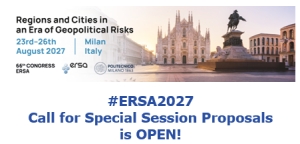
#ERSA2027 Call for Special Session Proposals is OPEN
|
||||||||||||||||||||||||||||||||
|
||||||||||||||||||||||||||||||||





Winner of 2026 RSAI Dissertation Award: Max Roessler
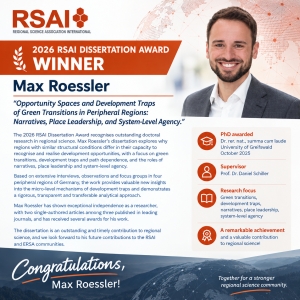
 Doctor Max Roessler has been chosen as the winner of the 2026 RSAI Dissertation Award for his work "Opportunity Spaces and Development Traps of Green Transitions in Peripheral Regions: Narratives, Place Leadership, and System-Level Agency."
The dissertation asks a central question in regional science: why do regions with similar structural conditions differ in their capacity to recognize and realize development opportunities? Examining this in the context of green transitions, it brings the literature on development traps and path dependence together with recent work on opportunity spaces, change agency, place leadership, and system-level agency.
The empirical work is excellent, drawing on extensive interviews with regional stakeholders in four peripheral regions of Germany, observations from regional events, and two cross-regional focus groups. As one committee member put it, narratives are treated "not as background colour but as an indicator of regional trajectory," and they are examined through a transparent multidimensional narrative analysis that can be applied elsewhere. A key finding is that regions can become locked into "maintenance agency" when negative narratives dominate, even where green transitions have opened real opportunities. This gives the development-trap literature micro-level mechanisms that existing indicators cannot capture. Dr Roessler has also demonstrated his independence as a researcher, with two single-authored articles among the three published in leading journals in the regional science field, and has received several awards for his work.
Overall, the dissertation is an outstanding and timely piece of work that deepens our understanding of place-sensitive green transitions, and we look forward to his future contributions to the RSAI and ERSA communities.
Dr Roessler was awarded his doctorate (Dr. rer. nat., summa cum laude) by the University of Greifswald in October 2025, under the supervision of Prof. Dr. Daniel Schiller.
New Issue: Papers in Regional Science | Volume 105, Issue 5, October 2026
Articles
Book reviews
|

About Us
The Regional Science Association International (RSAI), founded in 1954, is an international community of scholars interested in the regional impacts of national or global processes of economic and social change.