|
|
ERSA Monthly news & updates
|
|
In this issue you will find:
- ERSA2026 News
- Welcome ERSA´s new section
- Journals news
- Upcoming events
- Sections news
- Job Opportunities
- Publications
We wish you a good reading
|
|
|
|
|
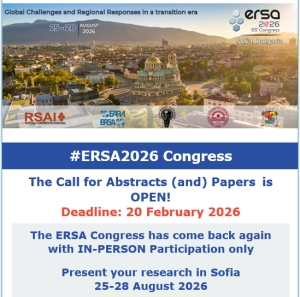
? #ERSA2026: Last chance!
Special Session Proposals has New Deadline!
As you may already know, the deadline for Special Session Proposals for the 65th ERSA Congress in Sofia has been extended to 7 January 2026 and this is the final deadline.
No further extensions will be granted.
Under the theme:
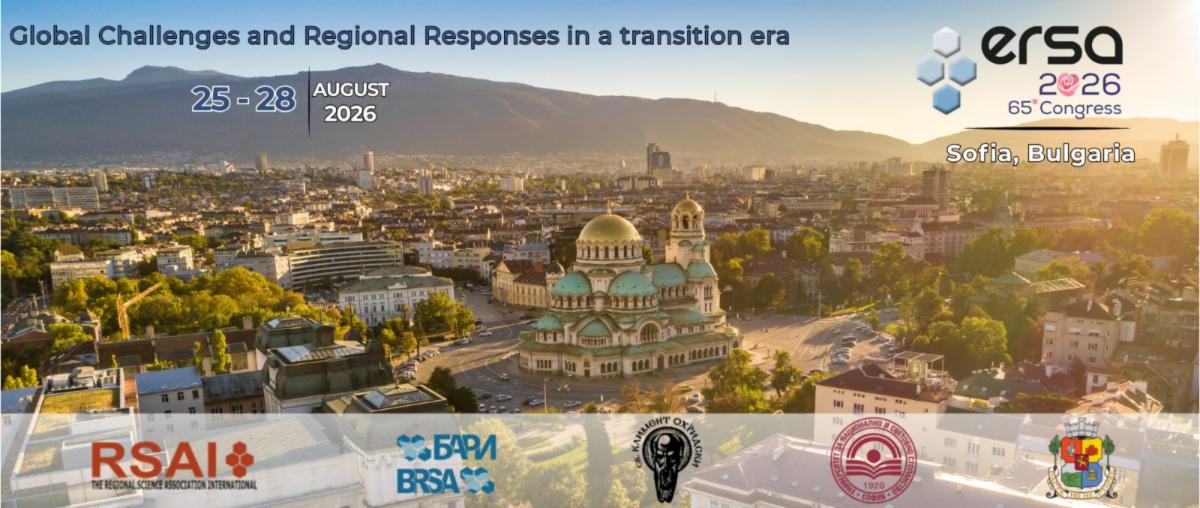
“Global Challenges and Regional Responses in a Transition Era”
This is an opportunity to:
Add value to the #ERSA2026 programme.
Lead a focused discussion on a topic you care about.
Engage with a global community of researchers and policymakers.
? New Deadline to submit proposals: 7 January 2026
?️ Congress dates: 25–28 August 2026
? In-person | Sofia, Bulgaria
|
|
See You in Sofia!
#ERSA2026 Host City Preview
|
|
?? Welcome to the Serbian Section!
|
|
|
We are pleased to announce that the Serbian Section will officially become part of the ERSA network as of 1 January 2026.
This marks an important step in strengthening the regional science community in South-East Europe. We warmly welcome our new colleagues and look forward to future collaborations!
Stay tuned for updates on our website and social media.
|
|
|
|
|
|
Global Challenges and Regional Science (GCRS)
Check out the latest paper:
Volume 5 - March 2026
Pro-independence feelings and the economic impacts of a secession: a study for the region of Catalonia
Authors:Claudia V. Montanía, Alberto Franco-Solís, Esteban Fernández-Vázquez, Geoffrey J.D. Hewings
more information about this issue
|
|
|
|
|
|
Regional Science Policy & Practice (RSPP)
Call for Papers | RSPP Special Issue: Impacts of War in Ukraine: Perspectives and Challenges
Guest Editors: Kateryna Zabarina - University of Warsaw.
Submissions extended deadline: February 28th, 2026
more information here
Check out the latest paper:
Volume 18, Issue 2
Exploring spatial disparities of work-shaped social vulnerability and resilience across the French Alps
Authors: Philippa Shepherd and Jean-Christophe Dissart
more information about this issue
|
|
|
|
|
Papers in Regional Science (PiRS)
Latest Article:
Volume 105, Issue 1
Multidimensional measures of quality of life: A comparison of methods using U.S. county-level data
Authors: Yang Cheng, Tessa Conroy, Steven C. Deller
more information about this issue
|
|
|
|
|
|
New Article in REGION Vol. 12 No. 2 (2025)
Latest Article: Know your competitor! Analyzing and predicting the location of competing stores : The case study of Valora at Swiss railway stations
Authors:Thomas Wieland
more
|
|
|
|
|
|
News from Scienze Regionali
New Issue (3/2025) – The latest special issue of Scienze Regionali, guest-edited by Maurizio Mussoni and Laura Vici, explores “Exogenous Shocks and Resilience in Tourism: A Regional Science Perspective.” Explore the issue
Special Issue Highlight (1/2025) – The special issue “The Future of European Competitiveness: The Regional Dimension”, guest-edited by Roberta Capello, gathers leading scholars to reflect on the regional dimension of the Draghi Report—published exactly one year ago—discussing productivity, resilience, and regional disparities in Europe. Explore the issue
|
|
|
|
|
|
New Issue in Review of Regional Research (RRR) Vol. 45 Issue 4August 2025
This issue of Review of Regional Research includes contributions focusing on novel methods to capture regional inequalities, wind energy industrial path development,
innovation in peripheral regions, niche market leaders within industrial districts, and the influence of interregional trade on regional economic growth.
Article that you can find in this new issue: Hybrid neural network with image caption generator for spatio-temporal income inequality and poverty estimation: A case study in Ecuador
Authors: Adriana Uquillas, Stéfano Cruz
Access to all publications here
|
|
|
|
|
|
Investigaciones Regionales - Journal of Regional Research Investigaciones Regionales - Journal of Regional Research has published the 63rd Issue, the third volume corresponding to 2025.
Special Issue 2025 Well-being and quality of life in Latin American and Caribbean cities: progress and challenges:
Latest Article:
Regional disparities in amenities and the life satisfaction of internal migrants
Authors: Grace Carolina Guevara-Rosero, Alexander Sarango-Iturralde, Andrés García-Suaza
Access to all publications here
We invite authors to submit papers here
|
|
|
|
|
|
Latest issue of Romanian Journal of Regional Science
Vol.19, No.2, Winter, Issued December 2025
Latest Article:Effects of export taxes in an endogenous growth model with industrial location
Authors: Wataru Johdo, Tokyo Keizai University, Japan
More information about this issue here
|
|
|
|
|
|
Journal of Regional & Urban Economics (JRUE/RERU)
Call for Papers - Special issue
Which methodologies for addressing the question of public services in territories?
This special issue of the Journal of Regional & Urban Economics (JRUE/RERU) aims to focus on the measurement and qualification of accessibility to public services, a topic that remains seldom explored in the literature, although central to current debates and controversies on territorial inequalities.
Spatial and temporal analysis; statistical and cartographic data, simulations, models or projections; quantitative, qualitative or mixed methods; original or innovative data are welcome in this issue.
2 page proposals are expected by 31 January 2026
Find out more
|
|
|
|
|
|
Hungarian Section
8th Geography of Innovation Conference
Corvinus University, Budapest, 28 – 30 January 2026
Extended abstract or paper submission deadline: 14 July 2025
More details available here
XIV Scientific Conference on Landscape History – History Creating Landscape
Pécs, 5-6 February 2026
more
|
|
|
|
|
|
British and Irish Section
The British and Irish Section are pleased to announce the fourth annual Online Early Career Colloquium, which will take place on the 21st and 22nd of January 2026. This is a great opportunity for PhD researchers and early career researchers (within 3 years of their PhD) to present and discuss their work with experienced academics in their field. We welcome PhD researchers at any stage of their PhD. First-year PhD students are encouraged to apply and may present research plans or works in progress.
Attendance at the colloquium is free. There are also prizes for the best paper and the best presentation. Prize winners will receive a certificate and will be invited to attend our annual RSAI-BIS conference in Belfast in May 2026, for free. The prize covers conference fee, accommodation, and economy-class travel costs.
Successful presentations and papers will clearly demonstrate the location of the research within the regional science literature and clearly explain the theoretical and/or conceptual frameworks in regional science to which their work contributes.
Abstracts can be submitted up to December 12th and the details are available on the Section website: Early Career Colloquium 2026 - Regional Science Association International.
If you have any questions in relation to the event please contact the organiser, Dr Daragh O’Leary at This email address is being protected from spambots. You need JavaScript enabled to view it..
|
|
|
|
|
|
British and Irish Section
The British and Irish Section is delighted to confirm that their 2026 annual conference will take place at Queens University, Belfast on May 13 and 14. Chair of the Local Organising Committee, Dr Kevin Mulligan, says that "the Belfast conference will be a great occasion, and it is wonderful to see the conference returning to Northern Ireland for the first time since 2007".
Belfast is served by two airports, Belfast International Airport and the George Best Belfast City Airport, with good connectivity to the rest of Europe. Dublin Airport has flights to the US, Asia, and Africa and has a direct bus connection to Belfast. Dublin to Belfast is two hours by bus or train. There are also ferry connections to Belfast from Liverpool and Cairnryan in Scotland.
So please mark the date in your diary and keep an eye on the Section website for more details.
The deadline for submission is February 13, 2026. The Section hopes you can join us for what is always a very enjoyable and stimulating event. The call for abstracts and information about the venue can be found here.
|
|
|
|
|
|
German Speaking Section
Call for Abstracts
Winter Seminar of the German Speaking Section of ERSA, 15-21 February 2026, Innsbruck / Austria
All contributions with a focus on regional/spatial phenomena and an economic, environmental, geographical or social science background are welcome!
Submit your extended abstract at www.gfr.ersa.org by 23 November 2025, indicating any time constraints, and take advantage of a winter seminar with ample time for engaging discussions and socializing opportunities.
Participation in the seminar is free of charge. Travel and accommodation costs, however, must be covered by the participants themselves.
New: Early-career researchers can apply for a grant subsidizing accommodation costs
when submitting their abstract.
Contact: This email address is being protected from spambots. You need JavaScript enabled to view it.
More information at:
Submission site
Call for abstract
|
|
|
|
|
|
Italian Section
Call for papers – XLVII Annual Scientific Conference
Florence, June 24-26 2026
REGIONS BETWEEN INNOVATION AND SUSTAINABILITY: THE CHALLENGES FOR DEVELOPMENT POLICIES
The Italian Association of Regional Science (A.I.S.Re), the Italian section of the Regional Science Association International (RSAI), announces its 47th Annual Scientific Conference.
The conference, which welcomes contributions from national and international scholars across a variety of disciplines related to regional science, will be held at the Dipartimento di Scienze per l’Economia e l’Impresa, Università di Firenze, Polo delle Scienze Sociali di Novoli, Florence.
More information: here
“GIORGIO LEONARDI” 2026 - BEST PH.D. DISSERTATION AWARD - XLI EDITION
To promote the diffusion of Regional Science among young scholars, AISRe (the Italian Section of the Regional Science Association International) has established an annual award for two Ph.D. dissertations in memory of Giorgio Leonardi. Applications must be send within the deadline of March 3rd, 2025.
“AISRe” YOUNG AUTHOR BEST PAPER AWARD 2026 - XVIII EDITION
To promote the diffusion of Regional Science in the Italian university system, AISRe has established an award for the most original and innovative paper presented by a young scholar at its annual scientific Conference. Candidates must send the abstract and paper through the Association’s website by March, 3rd, 2026.
Complete information at the following LINK
|
|
|
|
|
|
Portuguese Section
Call for Papers | 33rd APDR Congress, June 30-July 3, 2026, Polytechnic University of Cávado and Ave, Barcelos, Portugal
The APDR invites regional scientists, economists, managers, sociologists, geographers, urban planners, engineers, policy makers, and researchers of related disciplines to participate in the 33rd APDR Congress with the theme "Interregional Governance, Cohesion and Sustainability: Overcoming Territorial Inequalities for a Balanced Future" that will be held from 2 to 3 of July, 2026, at the Polytechnic University of Cávado and Ave, Barcelos, Portugal. On June 30 and July 1, 2026, just before the main conference, a Sustainable Regional Development Academy will be organized for a limited number of participants.
The theme “Interregional Governance, Cohesion and Sustainability: Overcoming Territorial Inequalities for a Balanced Future” underscores the growing importance of collaborative frameworks that promote equitable and sustainable development across regions. In the face of persistent territorial disparities, effective interregional governance emerges as a key mechanism for fostering cohesion, resilience, and shared prosperity. By integrating economic, environmental, social, and cultural dimensions, this approach seeks to ensure that sustainability is achieved not only within individual regions but also across territorial boundaries, paving the way toward a more balanced and inclusive future.
The call for papers and Special Session Proposals is open, and your participation is very welcome!
Deadline for Special Session proposals: February 1, 2026. Proposals should be sent by email to the Congress secretariat (This email address is being protected from spambots. You need JavaScript enabled to view it.).
Deadline for Abstracts submissions: April 2, 2026. Authors should submit their abstracts through the online submission system by following the link https://cmt3.research.microsoft.com/APDR2026
Deadline for Academy Applications:March 15, 2026.
All information available at the congress website: https://apdr.pt/congresso/2026/index.html
Looking forward to hosting you in Barcelos, Portugal!
The Organizing Committee and the Board of APDR
33rd APDR Congress
|
|
|
|
|
|
Romanian Regional Science Association has a new President!
Details
|
|
|
|
|
Call for Applications – PhD Positions in Rural Entrepreneurship (Marie Curie DN)
The Deadline for applications is now January 6, 2026.
We are pleased to share a call for two Doctoral Candidates in the field of Rural Entrepreneurship, based at the University of Aveiro, Portugal, within the framework of the EPHEMERAL project (Marie Curie Doctoral Network – Horizon Europe).
Research Topics:
1. Rural tourism and heritage identities
2. Food networks & place-based communication beyond the rural
Project website: www.sdu.dk/clf/EPHEMERAL
? Full call and application details available here:
https://www.ua.pt/en/sgrh/concursos-outras-posicoes
An excellent opportunity for early-stage researchers interested in rural sociology, rural tourism, and place-based development. We kindly encourage ERSA members to share this call with their networks.
|
|
|
|
|
RESEARCHER ASSISTANT POSITION IN THE BAROWEALTH PROJECT
UNIVERSITY OF OVIEDO - REGIOLAB
The University of Oviedo is seeking a researcher to join the BAROWEALTH project (CN-UE-25-BAROWEALTH), focused on spatial disaggregation of economic data. The successful candidate will work on estimating and analyzing household income distribution at local levels across NUTS3 subregions in EU and EFTA countries. The main objective is to develop a comprehensive database of localized income indicators spanning a long time period.
Applicants are required to possess a minimum of a Master's degree, or an equivalent postgraduate qualification, in Economics. Proven proficiency in the programming languages (R, Stata) is also essential. Published research articles in indexed journals related to economics or economic geography will be highly regarded. In addition, strong proficiency in both English and Spanish communication skills is essential.Prior research experience in economics or related fields is expected.
The position offers a full-time contract under the Spanish Science Law, with an expected start date of January 15, 2026 and the project runs until August, 2027. Two positions are available, and the work will be conducted at the Universidad de Oviedo within the research group REGIOlab (www.regiolab.es).
The application deadline is December 31, 2025. If interested, the link for applying is here.
|
|
|
|
|
|
Share Your 2025 Book Publication with the RSAI-ERSA Community
Are you a member of the RSAI-ERSA Community and have recently published a book (preferably written in English)? Don’t miss this opportunity to share your work with our network send the details to This email address is being protected from spambots. You need JavaScript enabled to view it..
|
|
|
|
|